
Jackson County Court Records After a Jail Arrest
The arrest is the start of the story, not the record itself. When deputies, Carbondale or Murphysboro police, or state troopers bring someone to the Jackson County Jail, the jail handles booking. The court record opens later, when the prosecutor files formal charges. In Jackson County that prosecutor is the State's Attorney, Marsha L. Cascio-Hale, whose Criminal Division handles felony and misdemeanor cases for the people of the county. The filing creates a case number, and that case number is the thread you follow through every court record that comes after the arrest.
It helps to keep two systems apart. The custody side covers who is in the jail and what they were booked on, and that detail sits with the Sheriff's Office. For the booking and roster side, the jail inmate records page covers how to confirm custody, and booking photos are handled on the jail mugshots page. The court side is different. Court records show the charges the prosecutor actually filed, the hearings set by the judge, and how each charge is finally resolved. Both sides start with the same arrest, but they live in separate places.
How to Find Jackson County Court Records After an Arrest
Filed criminal cases for Jackson County are posted through Judici, the online case-information service the county, Circuit Clerk, and State's Attorney all link. The court code for Jackson County is IL039015J. Booking and arrest detail does not appear here. What shows up is the charge record once the case is filed, along with hearing dates and how the case moves. The Circuit Clerk, Christian M. Hale, keeps the official file behind that online index.
- Open the Judici case search and confirm the court is set to Jackson County, the selector value IL039015J.
- Search by the defendant's name or by a known case number.
- Open the matching case and read the full list of charges the prosecutor filed.
- Check each charge for its statute citation, class or level, and current status.
The reader should know one limit up front. A direct check of the Jackson County case-search page reached a CAPTCHA screen before the search fields loaded, so only the court selector is confirmed below. The participating-courts list verifies the Jackson County code, and the data set Judici publishes for the county includes litigant information, criminal charges, dispositions and sentences, civil judgments, fines and fees, hearing dates, case minutes, and documents.
Court records are public under the Illinois Freedom of Information Act, 5 ILCS 140, though active criminal files carry exemptions. For a statewide criminal-history lookup that crosses county lines, the formal channel is a state-level background check rather than a single county index, and the county case record still has to be read on Judici or at the Circuit Clerk.
The Judici entry point for Jackson County is the Judici case-search page, where the court selector carries the IL039015J value.
That page is the spot where a filed charge after an arrest becomes a searchable court record once the prosecutor has opened the case.
| Field Label | Type | Required | Notes |
|---|---|---|---|
| Select a court | Dropdown | Yes | Includes Jackson County, IL with value IL039015J. |
| Search | Action | Yes | Routes to the Jackson County case-search page. |
| Case-search fields | CAPTCHA-gated | Unknown | Direct inspection did not expose the name or case-number fields. |
Note: Judici is run by Judici.com and not by the court, so certified copies of any court record come from the Circuit Clerk rather than the website.
How Charges Get Filed After an Arrest
Booking comes first at the jail, then the court charge record begins when the prosecutor files a charging document. The document used depends on the offense and the stage of the case. A misdemeanor often moves on a complaint, many felonies proceed on an information, and the most serious felonies can go before a grand jury for an indictment. Each one opens the same kind of court case, but the route into court differs.
| Complaint | Information | Indictment | |
|---|---|---|---|
| Filed By | Officer or Prosecutor | Prosecutor | Grand Jury |
| Common For | Misdemeanors | Many felonies | Serious felonies |
| Starts | The case | The case | The case |
The first court date after a jail arrest is the first appearance, where the judge addresses rights, counsel, and whether the person is released or detained. Arraignment is the stage where charges are formally read and a plea can be entered. Both appear in the court record, with dates the reader can track on the case docket.
Charge Status in the Court Record
Charges do not stay frozen as a case moves. They can be amended, reduced, added, dropped, or thrown out. This is why the charge booked at the jail after an arrest may not match what the court record finally shows. Booking charges reflect what the arresting agency alleged on the night of the arrest. Court charges reflect what the prosecutor chose to file and prove. The status terms below are the ones that show up most often.
| Status | What It Means |
|---|---|
| Pending | The charge is filed and the case is still open, with no final ruling yet. |
| Amended / Reduced | The charge was changed, often to a lower class or a different count. |
| Dismissed | The charge was dropped by the court and is no longer being pursued. |
| Nolle Prosequi | The prosecutor chose not to pursue the charge, ending it without a conviction. |
Bond and Release After a Jackson County Arrest
Release after an arrest changed sharply in Illinois. The state ended cash bail on September 18, 2023, under the Pretrial Fairness Act, and became the first state to do so. Under 725 ILCS 5/110-6.1, everyone is presumed eligible for pretrial release. To keep a person detained, the State must file a verified petition and meet a clear-and-convincing burden at a hearing for the offenses the law allows. A judge decides at first appearance, so the court record, not a bail bond desk, is now where the release question is answered.
Local payment language still uses the word "bonding." The Jackson County Jail commissary and bond page lists acceptable payment as cash, a cashier's check, or a money order from a local bank, with no personal checks. A cashier's check or money order must be payable in the inmate's name and presented during normal banking hours so a deputy can verify it. Credit-card payment runs through Court Money using JCSO ID #1205, and handling fees apply, with Court Money questions handled at 1-800-352-9870.
| Type | How It Works |
|---|---|
| Pretrial Release | The current Illinois default, with conditions set by the judge when ordered. |
| Detention Order | A court order under 725 ILCS 5/110-6.1 denying release after a State petition and hearing. |
| Cash / Money Order Payment | Local channel still used for older cases, payable in the inmate's name and verified at the bank. |
| Hold or Detainer | A hold from another agency or court can keep a person in custody even after a payment. |
Note: a detainer is a hold placed by another agency, and a person with one may stay in custody even when the local court record shows release was approved.
Circuit Clerk and Certified Court Records
The online index is a starting point, but the official file lives with the Circuit Clerk. Christian M. Hale serves as Jackson County Circuit Clerk at 1001 Walnut Street in Murphysboro, with mailing to P.O. Drawer 730. The office can be reached at 618-687-7300, by fax at 618-684-6378, and is open Monday through Friday from 8 am to 4 pm. Certified copies of a court record, older paper files, and questions about a specific docket are handled here, not by the prosecutor.
The county courts page links the Circuit Clerk and its case index, as shown on the Jackson County Circuit Clerk page.
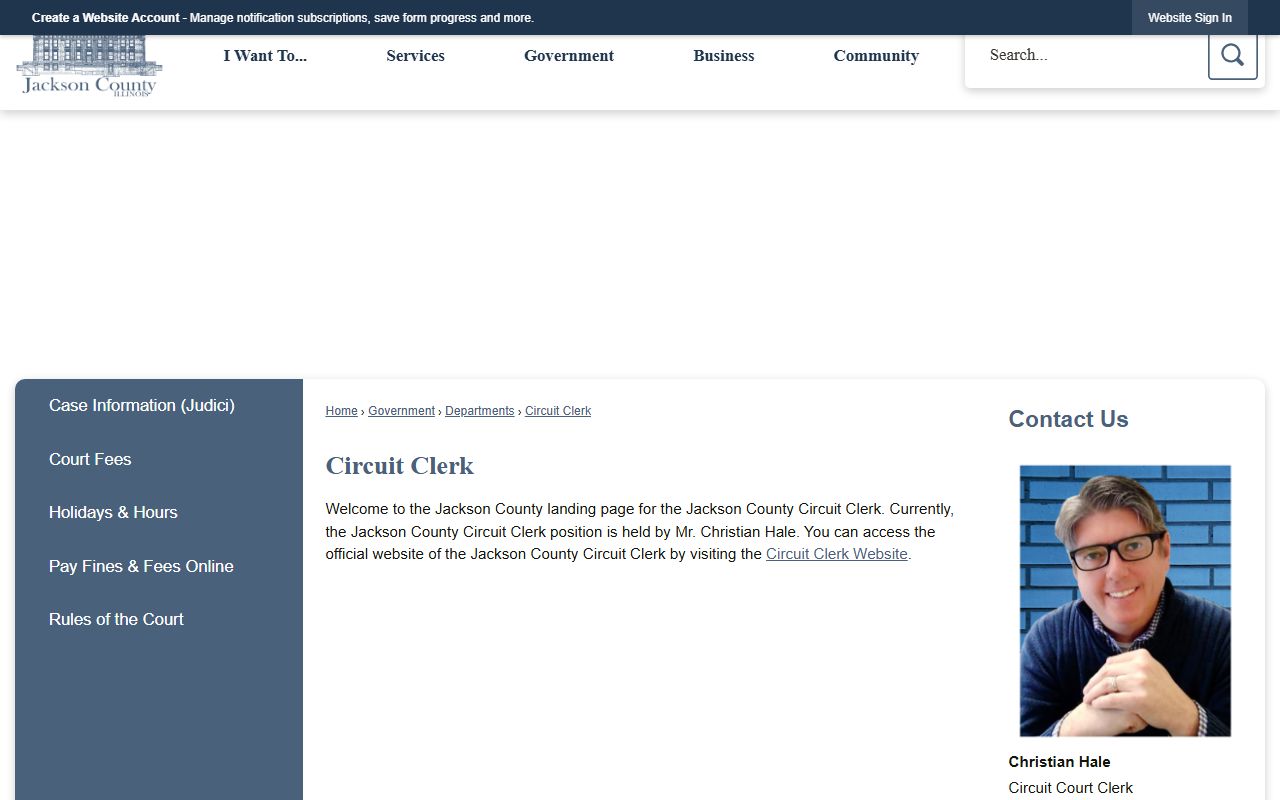
That office is the place to request a certified court record once a case has been filed after an arrest.
State's Attorney Records vs Court Records
The State's Attorney prosecutes the case but is not the keeper of the court file. The Criminal Division handles every felony and misdemeanor charge and works with victims and witnesses through the case. Its public-records page routes anyone seeking the court file to the Circuit Clerk or Judici. The office does keep its own records, and those are reached through a State's Attorney FOIA request, which covers prosecutor records rather than the main court docket and carries exemptions for active cases.
The prosecution side of a Jackson County arrest is described on the State's Attorney Criminal Division page.
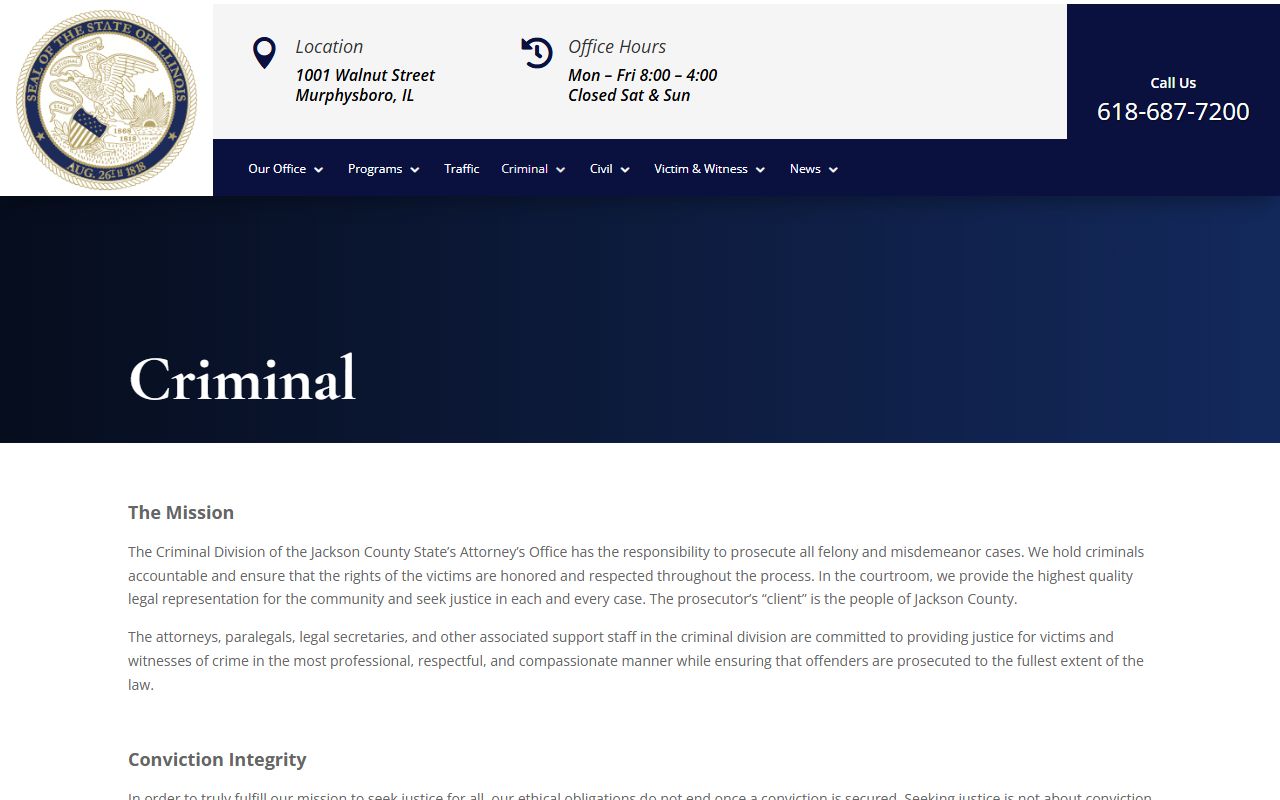
That page explains who decides the charges that turn an arrest into an open court record.
Warrants That Lead to an Arrest
Some arrests start with a warrant rather than a fresh call. No public Jackson County warrant search was located in official sources, so there is no online roster of active warrants to browse. The Sheriff's Office serves writs, warrants, summonses, and court orders, and can be reached at 618-684-2177. When a bench warrant ties back to a Jackson County court case, the case itself can be checked on Judici or with the Circuit Clerk at 618-687-7300.
A failure to appear, often shortened to FTA, means a missed court date, and county financial reports reference FTA warrant fees, which shows the court fee system tracks them. To confirm whether a warrant exists, a written FOIA request to the Sheriff's Office is the formal route, though active warrants can be withheld where disclosure would interfere with enforcement or safety.
- Arrest warrant
- A court authorization to take a named person into custody.
- Bench warrant
- Usually issued by a judge for a missed court date or noncompliance.
- Failure to appear
- A missed court appearance that can trigger a new warrant and added fees.
Charges vs. Convictions in Court Records
A charge is an accusation, and being arrested and charged is not the same as being found guilty. The court record after an arrest can show open charges for months before anything is decided. Reading a case correctly means separating what was filed from what was proven.
| Charge | Conviction | |
|---|---|---|
| Stage | Accusation | Verdict or plea |
| Burden of Proof | Probable cause | Beyond a reasonable doubt |
| Public Record | Yes | Yes |
Sealed vs. Expunged Arrest Records
An arrest record and the court file that follows it can sometimes be cleared. Illinois handles this under the Criminal Identification Act, 20 ILCS 2630/5.2, through a petition filed in the circuit court where the arrest happened or the charges were brought. Sealing and expungement are not the same thing, and eligibility turns on the disposition, the offense, and any waiting period set by statute.
| Sealed | Expunged | |
|---|---|---|
| Visibility | Hidden from most public view | Destroyed or treated as never existing |
| Law Enforcement | Limited access remains | Very limited access |
| Eligibility | Many records after the case ends, per 20 ILCS 2630/5.2 | Often arrests with no conviction or eligible dispositions, per 20 ILCS 2630/5.2 |
Note: sealing or expungement reaches the official court record but does not force third-party websites that reposted an old arrest to take their copies down.
Background Check Considerations
People read court records after an arrest for very different reasons. Some are following a relative's case, and some are running a hiring or housing check. Those are not the same task. A formal background check used for employment, tenants, or credit is regulated by the federal Fair Credit Reporting Act and must run through a licensed consumer reporting agency that follows its accuracy and notice rules. A casual look at a public court record is not that.
Important: This is not a consumer reporting agency under the FCRA, and nothing here may be used for hiring, tenant screening, credit, or any other FCRA-covered decision.
Restricted Court Records After an Arrest in Jackson County
Not every court record after an arrest is open to the public. Juvenile matters are restricted, sealed cases drop out of the public index, and dismissed charges may be withheld once a record is cleared. Files tied to an active investigation can be held back under the Freedom of Information Act where release would interfere with the case or threaten safety. The State's Attorney FOIA channel carries similar exemptions for ongoing prosecutions, confidential sources, and juvenile information. When a record cannot be found online, the most reliable next step is the Circuit Clerk for the court file or a written FOIA request to the agency that holds it.